Choosing reliable Polyethylene Board suppliers in China requires more than comparing online prices. The material’s performance depends on resin grade, density, thickness control, surface finish, and processing consistency. A board that looks smooth under warehouse lighting may warp after outdoor exposure or heavy machining. Buyers should therefore examine production experience, inspection records, and application-specific samples before signing a contract.
Industry data shows why this decision matters. PlasticsEurope reported global plastics production of approximately 400.3 million tonnes in 2022, with China contributing about 32% of the total. The OECD’s Global Plastics Outlook also highlights rising plastic consumption and growing pressure for better resource efficiency. These trends support careful supplier selection, especially when boards are used in packaging, marine components, construction protection, or industrial fabrication. Ask whether the supplier can provide resin traceability, dimensional reports, and relevant test results, such as density, tensile strength, impact resistance, and water absorption. ISO 9001 certification can support process control, but certification alone proves little.
A practical evaluation should include factory audits, independent sample testing, and clear communication about tolerances. Check the actual board, not only a brochure. Review extrusion lines, storage conditions, cutting accuracy, and export packaging. Suppliers should explain their polyethylene grade and provide consistent technical documentation. However, no supplier scorecard is perfect. A low-cost factory may perform well on standard boards but struggle with custom colors or tight tolerances. That limitation deserves attention. This guide examines how to compare Chinese Polyethylene Board suppliers through evidence, technical fit, quality assurance, sustainability awareness, and dependable long-term service.
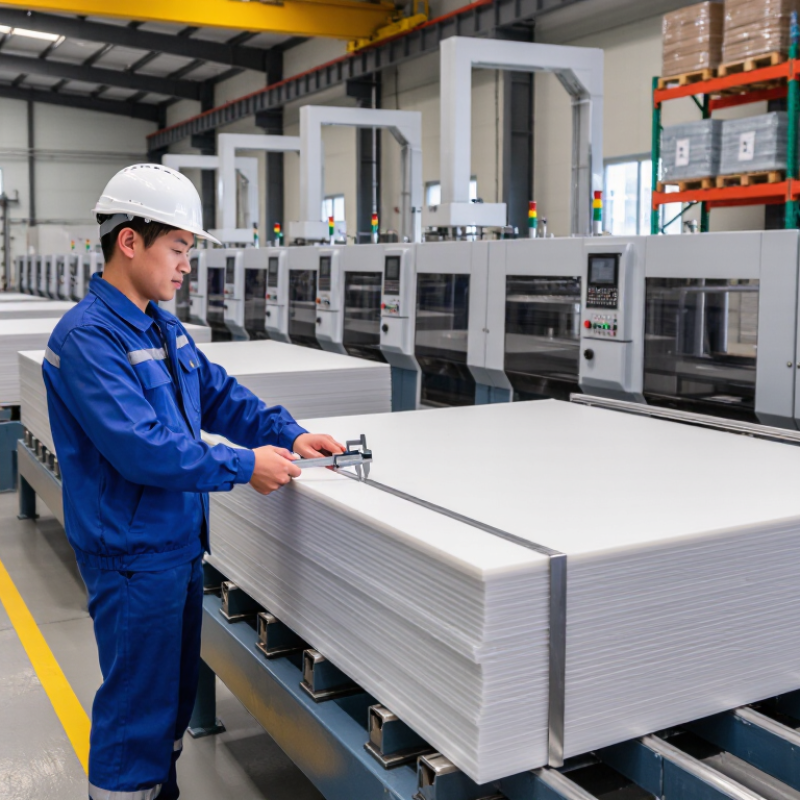
Choosing a polyethylene board supplier in China starts with understanding the material type, not the sales brochure. High-density polyethylene offers good stiffness, moisture resistance, and easy machining. It suits cutting boards, wear strips, tanks, and general fabrication. Ultra-high-molecular-weight polyethylene provides stronger abrasion resistance and a lower friction surface. It performs well in chutes, liners, and sliding guides. Low-density polyethylene is softer and more flexible. It works better for impact absorption and light-duty protection.
Performance depends on more than density. Check abrasion loss, impact strength, tensile data, friction behavior, and working temperature. A board exposed to sand and repeated sliding needs different properties from one used near cleaning chemicals. Thickness tolerance also matters. A 20-millimeter board that varies by several millimeters can create fitting problems during installation. Ask suppliers for test reports, production tolerances, and samples from current manufacturing batches.
I once compared two boards by appearance alone. That was a weak method. The smoother sheet was not automatically the stronger one. A practical evaluation should include drilling, cutting, bending, and repeated contact with the real mating material. Suppliers with technical staff can explain grade selection and processing limits clearly. They should also provide traceable specifications, stable dimensions, and realistic delivery information. No single polyethylene grade is best for every project. That point is easy to overlook.
How to Choose Top Polyethylene Board Suppliers in China?
Before comparing Chinese suppliers, define the board specification in measurable terms. State the polyethylene grade, density, thickness, width, length, and acceptable tolerances. Also describe the working environment. Will the board face moisture, chemicals, sunlight, impact, or continuous friction? These details influence material selection and processing costs.
Request test data for tensile strength, impact resistance, hardness, water absorption, and operating temperature. ISO 527 and ASTM D638 can support comparable tensile testing. For outdoor projects, ask for UV-stability evidence and weathering results. PlasticsEurope’s Plastics—The Fast Facts 2023 reported global plastics production of 400.3 million tonnes in 2022. Such production scale is impressive, but it does not guarantee consistent board quality. Small differences in density can affect weight, machining, and wear. I have seen specifications fail because “standard thickness” meant different values to different suppliers.
Tips: Prepare a one-page specification sheet. Include drawings, hole positions, surface requirements, color limits, and inspection methods. Ask for a sample from the same production process. Check its actual thickness at several points. Do not judge quality by appearance alone. If the board contacts food or drinking water, identify the required compliance documentation before ordering. A vague request often creates a cheap quotation and an expensive correction. Supplier audits, batch records, and third-party testing can provide stronger evidence than sales promises.
| Specification Dimension | Typical Data or Options | How to Define the Project Requirement | Supplier Information to Request | Verification Method |
|---|---|---|---|---|
| Material Type | HDPE UHMW-PE Recycled PE Virgin PE | Choose HDPE for general fabrication, chemical resistance, and outdoor utility applications. Choose UHMW-PE when very high abrasion resistance and low friction are required. | Polymer type, virgin or recycled content, grade designation, and material safety documentation. | Review the technical data sheet and compare the stated density, mechanical properties, and intended applications with the project needs. |
| Density | HDPE is commonly approximately 0.93–0.97 g/cm³; UHMW-PE is commonly approximately 0.93–0.95 g/cm³. | Use a specified density range when weight, stiffness, wear resistance, or machining behavior is important. | Nominal density, test method, lot-to-lot tolerance, and whether fillers or recycled material are included. | Request a batch test report and verify density using an applicable plastics density test method. |
| Board Thickness | Common commercial thicknesses include approximately 3–100 mm, subject to the supplier’s production capability. | Define the nominal thickness, permitted tolerance, flatness requirement, and whether the board will be machined or thermoformed. | Thickness range, thickness tolerance, measuring locations, maximum board size, and production process. | Measure several points across each board with a calibrated thickness gauge. Do not rely on a single edge measurement. |
| Length and Width | Custom dimensions are possible; practical limits depend on board thickness, press size, extrusion line, and handling equipment. | Specify finished dimensions, cutting allowance, dimensional tolerance, squareness, and acceptable edge condition. | Maximum manufacturing size, standard sheet sizes, cutting tolerance, and packaging dimensions. | Inspect a representative sample using a calibrated tape, ruler, or coordinate measuring equipment. |
| Color | Common options include natural, white, black, blue, green, yellow, and custom colors. | For non-critical applications, define a visual color requirement. For visible parts, specify a color reference, acceptable variation, and surface side. | Color reference, pigment or masterbatch information, color tolerance, and sample approval procedure. | Compare production samples with the approved reference under consistent lighting conditions. |
| UV and Weather Resistance | Natural polyethylene can degrade under prolonged sunlight. UV-stabilized grades generally use carbon black or other UV stabilizers. | For outdoor service, specify exposure duration, climate, required color retention, and whether UV stabilization is mandatory. | UV-stabilizer type, carbon-black content where applicable, weathering test data, and recommended outdoor service limits. | Review accelerated-weathering data and confirm that the tested formulation matches the supplied material. |
| Operating Temperature | Polyethylene remains useful at low temperatures, but stiffness decreases as temperature rises. A commonly cited continuous-use range is approximately -50°C to 80°C, depending on grade and load. | Define minimum and maximum temperatures, continuous or intermittent exposure, applied load, and contact with hot fluids. | Recommended service-temperature range, heat-deflection information, load conditions, and application limitations. | Check the grade-specific technical data rather than applying a generic temperature value to every polyethylene board. |
| Mechanical Strength | Typical HDPE tensile strength is often approximately 20–37 MPa, while values vary with grade, orientation, temperature, and test method. | Specify tensile, flexural, impact, compressive, or load-bearing requirements according to the actual design load. | Test method, specimen direction, tensile strength, elongation, flexural modulus, impact strength, and test temperature. | Compare the supplier’s report with the design calculation and, for critical parts, commission independent testing. |
| Abrasion and Friction | UHMW-PE generally provides better abrasion resistance and lower friction than standard HDPE. | Use UHMW-PE for wear strips, liners, guides, chutes, and sliding components where repeated contact occurs. | Wear rate, friction coefficient, counterface material, test load, test speed, and test environment. | Ensure wear data is based on a test condition similar to the real application; laboratory results are not universally interchangeable. |
| Chemical Compatibility | Polyethylene has good resistance to many dilute acids, alkalis, salts, and aqueous chemicals, but compatibility depends on concentration, temperature, and exposure time. | List every chemical, concentration, temperature, contact time, and whether the contact is continuous or intermittent. | Chemical-resistance chart, grade limitations, temperature limits, and previous application data without confidential customer information. | Confirm compatibility against a recognized chemical-resistance reference and conduct immersion testing when the application is critical. |
| Surface Finish | Available finishes may include smooth, textured, matte, machined, embossed, or laminated surfaces. | Define roughness, appearance, slip requirements, cleanability, and which side must meet the visual specification. | Surface-finish range, roughness measurement method, protective-film option, and approved sample. | Inspect the surface under controlled lighting and measure roughness when a numerical value is required. |
| Machining and Fabrication | Polyethylene boards can commonly be sawn, drilled, milled, routed, and welded using suitable procedures. | Provide drawings with hole tolerances, flatness, edge radii, threaded features, weld details, and post-machining requirements. | Machining capability, CNC tolerance range, welding process, distortion control, and inspection procedure. | Approve a first article or pre-production sample before authorizing full production. |
| Food, Water, or Regulatory Use | Compliance is grade-specific and depends on the destination market, composition, additives, and intended contact conditions. | State the contact medium, temperature, duration, destination market, and applicable regulatory requirement. | Declaration of conformity, migration test results, raw-material compliance documents, and traceability records. | Verify that documents identify the exact grade and are valid for the intended application and market. |
| Quality Control | Key controls may include incoming material inspection, thickness, dimensions, color, density, surface condition, and mechanical testing. | Create an inspection plan with sampling level, acceptance criteria, inspection tools, and corrective-action requirements. | Quality manual, inspection checklist, calibration records, batch traceability, nonconformance procedure, and sample reports. | Use pre-shipment inspection or an independent inspection agency for large or high-risk orders. |
| Documentation and Traceability | Useful documents include a technical data sheet, certificate of analysis, packing list, commercial invoice, and material declaration. | Specify document format, required language, batch-number format, retention period, and approval timing. | Sample document package, lot identification method, production date, raw-material lot, and final inspection record. | Match the batch number on the documents, packaging, labels, and product samples. |
| Packaging and Shipping | Boards are commonly protected with plastic film, edge protection, pallets, or export-grade crates, depending on size and destination. | Define moisture protection, stacking limits, lifting points, pallet dimensions, container loading plan, and marking requirements. | Packaging drawing, gross and net weight, pallet arrangement, shipping marks, and damage-claim procedure. | Inspect packaging before loading and photograph product condition, labels, and container placement. |
| Supplier Evaluation Criteria | Recommended evaluation areas: specification compliance, production capacity, quality system, documentation, communication, lead time, and after-sales response. | Assign project-specific weights instead of selecting solely by unit price. For safety-critical parts, give greater weight to traceability and testing. | Factory profile, process flow, equipment list, sample history, production lead time, inspection plan, and reference project category. | Score suppliers against the same written specification and validate key claims through samples, audits, or third-party inspection. |
Evaluating Chinese polyethylene board suppliers requires more than comparing prices. Start by confirming the material grade, density, thickness tolerance, and intended application. Ask for recent test reports covering impact strength, water absorption, temperature resistance, and surface hardness. A reliable supplier should explain test methods clearly, not only send attractive figures. Request a physical sample, then inspect its edges, flatness, color consistency, and machining behavior.
Factory experience matters. Review production equipment, raw-material storage, mold control, and inspection records through a video call or on-site audit. Check whether each batch has traceable production data. ISO certification can support credibility, but it does not replace product verification. Ask for sample approval procedures, corrective-action records, and references from similar industrial applications. Good answers are specific.
Communication is another practical test. Confirm minimum order quantities, packaging, lead times, replacement terms, and export documents in writing. A supplier promising everything immediately deserves careful questioning. No checklist is perfect. A polished factory tour may still hide weak process control, while a smaller plant may provide better technical support. Recheck assumptions after the first trial order, especially when board thickness or outdoor exposure changes. Reliable cooperation develops through measured testing, transparent records, and realistic expectations.
China’s polyethylene board market demands more than a low quoted price. Plastics Europe’s Plastics—The Fast Facts 2024 report records 413.8 million tonnes of global plastics production in 2023. This scale increases supplier choices, but it also makes verification essential. Request the material grade, density, thickness tolerance, and batch number before ordering samples. A reliable supplier should provide recent test reports, not only attractive product photos.
Check whether the factory operates under ISO 9001 quality management controls. Confirm certificates directly with the issuing body, including validity, factory address, and covered processes. For boards used near food or sensitive equipment, request applicable compliance evidence, such as migration testing or restricted-substance declarations. Test samples independently against relevant methods, including ISO 527 for tensile properties and ISO 1183 for density. Do not trust one report. Testing laboratories can make mistakes too.
Production capacity needs physical evidence. Ask for monthly output records, extrusion-line photographs, maintenance logs, and an inspection of the warehouse. Compare stated capacity with delivery history and electricity or raw-material usage where possible. The China Plastics Processing Industry Association has repeatedly highlighted efficiency and quality upgrading as industry priorities in its annual industry analyses. That does not prove every factory performs well. A supplier may hold valid certificates yet outsource production without clear disclosure. Visit the plant, inspect edge uniformity, and measure several points across each board. Small thickness differences can become expensive during installation. My own caution is simple: capacity claims are estimates until purchase records, equipment, and consistent test results support them.
Price comparison should begin with the board specification, not the supplier’s first quotation. Polyethylene resin costs, density, thickness, color, surface finish, and minimum order quantity can change the final price. Plastics Europe reported global plastics production of 400.3 million tonnes in 2022. This scale shows why raw material movements deserve regular monitoring. Request a complete quotation with product cost, packaging, export documentation, inland transport, and Incoterms. A low unit price can still become expensive after freight and customs charges.
Shipping needs equal attention. UNCTAD reports that over 80% of global merchandise trade by volume moves by sea. Ask for the loading port, estimated transit time, container capacity, and damage procedure. Compare FOB, CIF, and DDP carefully. The World Bank’s Logistics Performance Index 2023 highlights reliability as a key supply-chain factor. A supplier promising fast dispatch is not enough. Check production lead times, inspection records, carton strength, and tracking communication. I would not rely on one freight estimate. Rates change, and this is easy to underestimate.
Tips: Request two sample thicknesses and measure them independently. Ask for a resin certificate, dimensional tolerance, and recent inspection photos. Compare at least three written offers using the same specifications. Include payment terms and replacement policies. Supplier support matters after delivery. Test response speed with a technical question before placing a large order. A polished reply is useful, but consistent evidence is better.
Confirm the material grade, density, thickness tolerance, color, surface finish, and intended application. Request the batch number and recent test reports. Do not guess.
Inspect the edges, flatness, color consistency, and surface hardness. Measure thickness at several points, then observe cutting, drilling, or shaping behavior. A small sample can reveal large problems.
Ask for impact strength, water absorption, temperature resistance, density, and tensile-property results. The supplier should explain test methods clearly. One report is not enough.
Review extrusion equipment, raw-material storage, mold control, maintenance logs, and inspection records. Request monthly output evidence and recent delivery records. Capacity claims remain estimates without supporting documents.
Certificates support credibility, but they do not replace physical testing. Confirm the certificate’s validity, factory address, and covered processes. Also check whether production is outsourced.
Compare identical specifications, including resin type, density, thickness, color, packaging, and minimum order quantity. Include inland transport, export documents, freight, payment terms, and delivery conditions. A cheap unit price may mislead.
Confirm the loading port, production lead time, transit estimate, container capacity, and damage procedure. Ask how tracking updates will be provided. Fast dispatch sounds good, but records matter more.
Send a detailed technical question and measure the response time and accuracy. Request written replacement terms, sample approval steps, and corrective-action records. Polished replies are not proof.
Use a video call, factory visit, or independent inspection when practical. Check warehouse conditions, batch traceability, board uniformity, and inspection routines. No checklist is perfect.
Recheck thickness, flatness, color, packaging damage, and machining performance. Compare the delivered boards with the approved sample and written specification. I would not assume consistency yet.
Choosing the right Polyethylene Board supplier in China requires more than comparing prices. Buyers should first understand the differences among board types, including variations in density, thickness, surface finish, impact resistance, chemical resistance, temperature tolerance, and fabrication suitability. Clearly defining project requirements, such as dimensions, color, hardness, load conditions, operating environment, tolerances, and expected service life, helps ensure that suppliers provide accurate recommendations and quotations.
A reliable evaluation should include verification of material quality, testing procedures, certifications, production equipment, quality-control systems, and manufacturing capacity. Buyers should also request samples, technical data, inspection records, and evidence of consistent batch performance. Finally, compare total purchasing costs rather than unit price alone, considering tooling, packaging, shipping, lead times, payment terms, customization, warranty coverage, communication, and after-sales support. A supplier that combines stable quality, transparent documentation, dependable delivery, and responsive service is more likely to support a successful long-term project.

Beyond